





Multi-unit residential and institutional component permits drive December increase
The total value of building permits issued in Canada in December increased by $821.3 million (+6.8%) to $12.8 billion compared to November. Both the residential and non-residential sector recorded increases.
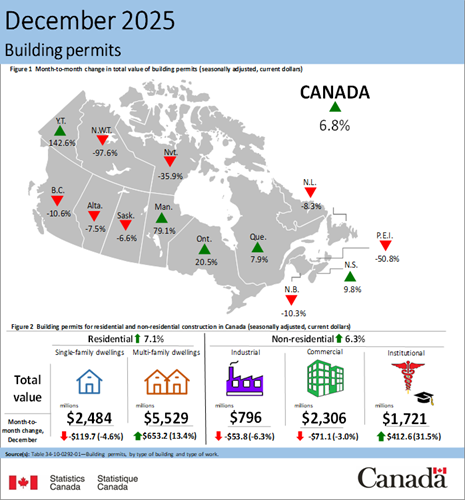 Residential construction intentions increased by $533.5 million for the month, reaching $8.0 billion. Gains recorded in the multi-unit component (+$653.2 million to $5.5 billion) were tempered by a decline in the single-family component (-$119.7 million to $2.5 billion).
The multi-unit component gains were largely attributed to Ontario (+$548.8 million), Manitoba (+$236.9 million) and Quebec (+$130.7 million). Six provinces and two territories contributed to the increase. The decline in the single-family component was driven by Ontario (-$75.4 million) and Saskatchewan (-$32.6 million).
Meanwhile, the value of non-residential building permits increased $287.8 million to $4.8 billion for the month. The institutional component (+$412.6 million) drove the growth, while both the commercial (-$71.1 million) and industrial (-$53.8 million) components moderated it.
The growth in the institutional sector was led by Ontario (+$317.0 million) in December, followed by Quebec (+$103.1 million) and Alberta (+$82.5 million). Meanwhile, declines in British Columbia (-$73.5 million), the Northwest Territories (-$32.5 million) and New Brunswick (-$26.5 million) tempered the overall increase.
In December, losses in the commercial component were driven by Alberta (-$146.4 million) and Quebec (-$69.3 million), with a total of seven provinces and one territory contributing to the overall decline. Gains in Ontario (+$110.5 million), along with two other provinces and two territories, tempered the overall loss.
Meanwhile, both the industrial and the commercial sectors recorded their second consecutive monthly decrease. Ontario (-$33.0 million) led the industrial decline, with six other provinces and two territories posting decreases.
Year in review, 2025
Year over year, the total value of building permits rose $3.3 billion to $149.7 billion in 2025. On a constant dollar basis (2023=100), the total value of building permits declined 1.3% from 2024 to $139.6 billion.
Permit values in the residential sector decreased $1.0 billion to $86.6 billion in 2025. This decline was driven by single-family construction intentions, falling 7.0% to $29.6 billion, the lowest annual level in the series.
Conversely, the multi-family component increased $1.2 billion to $57.0 billion in 2025, the second-highest level in the series.
Meanwhile, the number of units authorized for construction was up 19,100 to 308,600 in 2025, a record high. Gains in authorized multi-unit dwellings (+22,600) were moderated by declines in intentions to build single-family homes (-3,500).
The total value of non-residential building permits fell $739.8 million to $52.9 billion in 2025, the first annual decline since 2020. Quebec (-$2.1 billion) and Ontario (-$1.5 billion) contributed the most to the decline. Gains in Alberta (+$2.0 billion) and British Columbia (+$1.1 billion) along with three other provinces and one territory moderated the losses in the sector.
After reaching a record high in 2024, the total value of industrial building permits fell $3.4 billion to $9.4 billion in 2025. This decline offset the strong growth in the institutional (+$1.9 billion) and commercial (+$797.0 million) components.
The gains in the institutional component were mostly attributed to large construction intentions for hospitals and long-term care facilities concentrated in Ontario, British Columbia, Saskatchewan and Alberta. Overall, Alberta (+104.7%; +$1.5 billion) and British Columbia (+68.0%; +$1.5 billion) drove the component's annual gain, as Alberta experienced its largest recorded increase in 2025.